On this page
- Managers usually reach the role after 4 to 6 years of hands-on experience
- Performance and growth managers handling budgets tend to earn more
- Salary jumps come from owning results, not just years of experience
- Specialise early, then learn every channel to plan full campaigns
- Keep a results file: it becomes your case for promotion
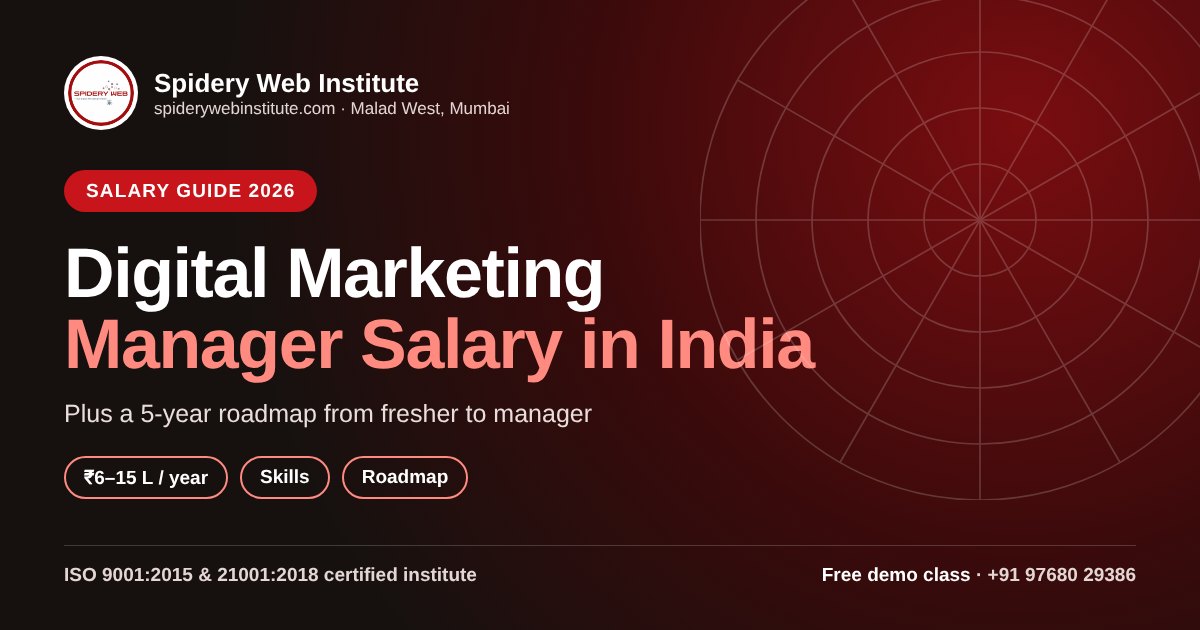
Quick answer: A digital marketing manager in India typically earns about ₹6–15 lakh a year depending on city, company and results, with performance-marketing and growth managers at the higher end. Most people reach manager level after 4–6 years by moving from executive to specialist to team lead.
A digital marketing manager plans strategy, manages budgets and leads a team or a set of channels. It is one of the best-paid roles in marketing — and one of the most reachable, because there is no fixed degree requirement. Here is what the role typically pays in India in 2026 and a realistic five-year path to get there.
Digital marketing manager salary by experience
Salaries vary by city, company size and results, but these indicative ranges reflect what we see in Mumbai job listings and our agency network:
| Stage | Typical title | Indicative salary (per year) |
|---|---|---|
| 0–1 year | Digital marketing executive / trainee | ₹2.4 – ₹3.6 lakh |
| 1–3 years | Executive / specialist (SEO, ads, social) | ₹3.5 – ₹7 lakh |
| 3–5 years | Senior specialist / team lead | ₹6 – ₹10 lakh |
| 5–8 years | Digital marketing manager | ₹9 – ₹15 lakh+ |
| 8+ years | Head of digital / growth | ₹15 lakh – ₹30 lakh+ |
Performance-marketing and growth managers — people responsible for paid budgets and revenue — usually sit at the higher end. Managers in Mumbai and Bengaluru typically earn more than in smaller cities. These are indicative ranges; actual offers depend on your results and the company.
Skills that raise your salary
- Performance marketing: managing Google and Meta Ads budgets profitably is the most directly valuable skill to employers.
- Analytics: GA4, Looker Studio dashboards and the ability to tie marketing to revenue.
- SEO with AI search: AEO and GEO are new, so few managers understand them well.
- Automation and AI: WhatsApp and email automation, CRM workflows and AI tools that save team time.
- Leadership and communication: briefing designers and writers, presenting to clients or founders and making decisions with data.
Year-by-year roadmap: executive to manager
Year 1 — learn the full funnel
Join as an executive or intern. Learn SEO, social media, ads and analytics hands-on, and say yes to every type of task. Build a portfolio of results.
Year 2 — pick a specialism
Go deep in one area: performance marketing, SEO or social media. Get certified in the platform (Google Ads, Meta Blueprint) and own real accounts.
Year 3 — own results
Take responsibility for a channel or a set of clients. Report on outcomes — leads, revenue, cost per acquisition — not just activity.
Year 4 — lead people
Mentor juniors, coordinate designers and writers, and start planning quarterly strategy. This is where many people become team leads.
Year 5 — manage strategy and budget
Combine channels into one plan, manage the full budget and present to leadership. With a strong track record, this is when the manager title — and salary jump — usually comes.
Certifications that help
- Google Ads and Google Analytics certifications
- Meta Certified Digital Marketing Associate / Media Buying
- HubSpot inbound and content marketing
- A practical, project-based course that leaves you with a portfolio
Certifications help you get shortlisted; results get you promoted.
How freshers can start the path
- Learn the fundamentals in a hands-on course with live projects.
- Build a portfolio and land an internship or executive role.
- Track your results from day one — they become your promotion case.
- Keep learning new platforms and AI tools every quarter.
Use our interactive digital marketing salary estimator to see ranges by role and experience.
Skills that move you from executive to manager
Salary jumps rarely come from years alone. They come from taking responsibility for results. These are the skills that separate managers from executives:
- Budget ownership: planning and defending a monthly ad budget, and showing return on ad spend.
- Strategy across channels: knowing when SEO, Google Ads, Meta Ads, email or WhatsApp is the right channel — not just running one.
- Reporting for decision-makers: turning analytics into a one-page summary a founder or client can act on.
- Team leadership: briefing designers and writers, reviewing work, and training juniors.
- AI and automation: using AI tools and automation to deliver more with a smaller team.
Five steps to speed up your growth
- Pick a specialisation (performance marketing, SEO or social) in your first two years and become the go-to person for it.
- Keep a results file: every campaign, its numbers and what you learned. This becomes your case-study portfolio.
- Volunteer for client calls and reporting meetings early.
- Learn the basics of every other channel so you can plan full campaigns.
- Get a mentor. Our alumni keep lifetime access to trainers for exactly this reason — advice on promotions, job switches and salary negotiations.
Follow these steps and the move from executive to manager in four to six years becomes realistic, with salary growth to match.
Frequently asked questions
What is the salary of a digital marketing manager in India? Roughly ₹6–15 lakh a year, higher in Mumbai and Bengaluru and for performance-marketing roles.
How many years does it take to become a digital marketing manager? Usually 4–6 years of hands-on experience.
Learn this hands-on
Start the path with Spidery Web Institute’s 5-month Advanced Digital Marketing + AI + Automation course in Malad West — taught inside a working agency, with live projects and placement support. Book a free demo class.
Frequently asked questions
What is the salary of a digital marketing manager in India?
How many years to become a digital marketing manager?
What skills does a digital marketing manager need?
Is an MBA needed to become a digital marketing manager?
Which specialisation grows fastest?
 Written by Faiza KhanPublished 30 October 2026 · Updated 12 November 2026 · ⏱ 4 min read