On this page
Quick answer: The most common digital marketing interview questions for freshers cover basics (SEO, SEM, social media), tools (Google Ads, Meta Ads Manager, GA4), metrics (CTR, CPC, ROAS) and a portfolio walkthrough. Prepare short, example-based answers and show one real campaign or website you built.
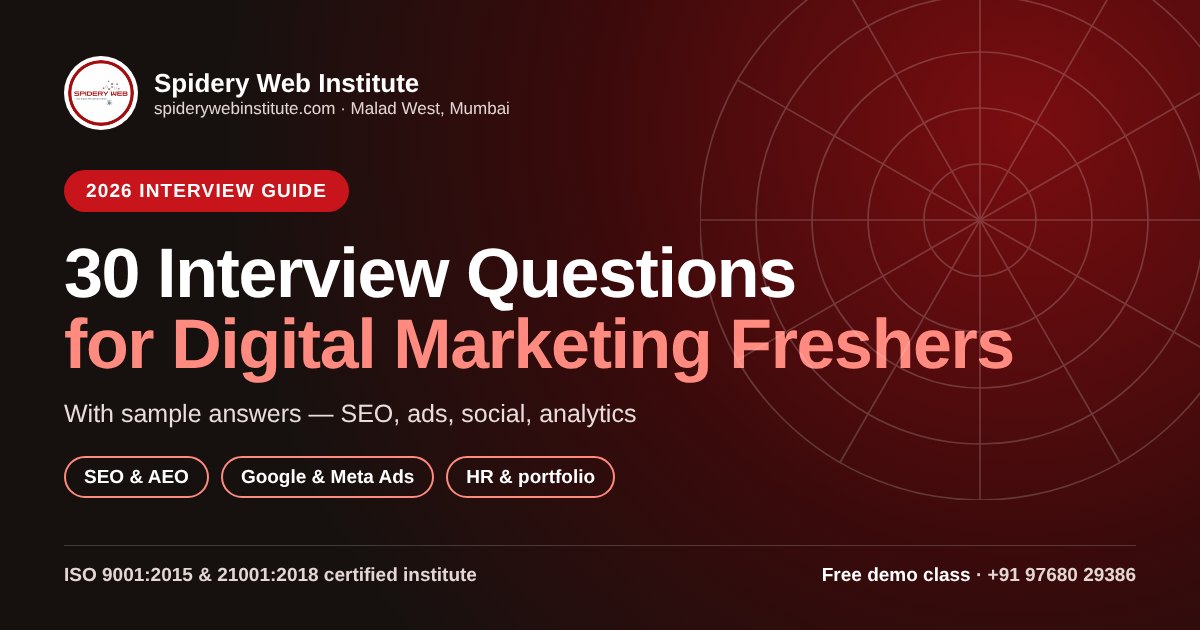
Your first digital marketing interview can feel unpredictable, but most freshers in Mumbai are asked the same kinds of questions: the basics of online marketing, a few tool-specific questions, the meaning of common metrics and, most importantly, “show me something you have done”. Prepare short, example-based answers for the 30 questions below and you will walk in far more confident than most candidates.
Tip before you start: for every answer, try to add one real example — a page you optimised, an ad you ran in class, a post that did well. Interviewers remember examples, not definitions.
Basic digital marketing questions
1. What is digital marketing?
Promoting a business through online channels — search engines, social media, email, websites, ads and messaging apps — to reach the right people and turn them into leads or customers. Mention that it is measurable, which is its biggest advantage over traditional marketing.
2. What is the difference between SEO and SEM?
SEO (search engine optimisation) earns free, organic rankings on Google over time. SEM usually means paid search — Google Ads — where you pay per click to appear at the top immediately. Good answer: “SEO builds long-term traffic, SEM brings quick, controllable traffic; most businesses use both.”
3. What is a marketing funnel?
The journey from awareness to consideration to conversion (and ideally loyalty). Give an example: a Reel creates awareness, a blog or landing page builds consideration, a WhatsApp follow-up converts the lead.
4. Who is a buyer persona?
A short profile of your ideal customer — age, location, problems, goals and where they spend time online. It decides your message, channel and budget.
5. Which digital marketing channel would you pick for a local business?
A Google Business Profile, local SEO, Google Search ads on “near me” keywords and Instagram for trust. Explain why: these reach people who are already searching nearby.
SEO and AEO questions
6. What are on-page and off-page SEO?
On-page is everything on your website: titles, meta descriptions, headings, content, internal links, image alt text and speed. Off-page is everything outside it: backlinks, brand mentions, reviews and citations.
7. What is a focus keyword and how do you choose one?
The main search term a page should rank for. Choose it using search volume, difficulty and — most importantly — intent: does the searcher want to learn, compare or buy?
8. What is a backlink and why does it matter?
A link from another website to yours. Quality links from relevant, trusted sites act as votes of confidence and help rankings.
9. What is AEO or GEO?
Answer Engine Optimisation and Generative Engine Optimisation — structuring content so Google AI Overviews, ChatGPT and Gemini can quote it: direct answers in the first lines, FAQs, schema and consistent business facts. Freshers who can explain this stand out in 2026.
10. Which SEO tools have you used?
Be honest. Google Search Console, Google Analytics 4, a keyword tool such as Semrush or Ahrefs, and Yoast or Rank Math on WordPress are good answers if you have practised with them.
Google Ads and Meta Ads questions
11. What is CPC, CPM and CTR?
CPC is cost per click, CPM is cost per 1,000 impressions and CTR is click-through rate (clicks ÷ impressions). Be ready to calculate: 50 clicks from 2,000 impressions is a 2.5% CTR.
12. What is Quality Score in Google Ads?
Google’s 1–10 rating of how relevant your keyword, ad and landing page are. A higher score usually means lower cost and better positions.
13. What are keyword match types?
Broad, phrase and exact match control how closely a search must match your keyword. Mention negative keywords too — they stop wasted spend.
14. How would you structure a Meta Ads campaign for lead generation?
Campaign objective “Leads”, one ad set per audience (for example interest-based and a lookalike), 2–3 creatives per ad set, an instant form with one qualifying question, and quick follow-up on WhatsApp.
15. What is ROAS?
Return on ad spend: revenue ÷ ad cost. A ROAS of 4 means ₹4 earned for every ₹1 spent. For lead businesses, talk about cost per lead and cost per qualified lead instead.
Social media and content questions
16. How do you plan a monthly content calendar?
Start from business goals, pick 3–4 content pillars (education, proof, behind-the-scenes, offers), decide formats and frequency, then schedule. Review what performed last month before planning the next.
17. What makes a Reel perform well?
A strong hook in the first two seconds, one clear idea, on-screen text, trending or original audio and a call to action. Measure saves, shares and DMs, not just views.
18. How would you handle a negative comment?
Reply quickly and politely, move the conversation to DM or phone, solve the problem and never argue in public.
19. What is the difference between reach and impressions?
Reach is the number of unique people who saw a post; impressions count every view, including repeats.
20. Which AI tools do you use for content?
Mention a chat assistant for research and first drafts, Canva AI for design and CapCut for video — and say you always edit for accuracy and brand voice.
Analytics and metrics questions
21. What is Google Analytics 4 used for?
Tracking website visitors, where they come from, what they do and which actions (conversions) they complete.
22. What is a conversion?
Any valuable action — a form submission, call, WhatsApp click or purchase. Every campaign should be measured against a conversion, not just clicks.
23. What is bounce rate or engagement rate?
In GA4, engagement rate is the share of sessions that lasted longer than 10 seconds, viewed two or more pages or converted. Low engagement usually means the page doesn’t match what the visitor expected.
24. How would you report results to a client?
One page: goal, spend, results, cost per result, what worked, what didn’t and next steps. Clients want decisions, not screenshots.
25. What is A/B testing?
Changing one element — a headline, image or button — and comparing two versions to see which performs better.
HR and portfolio questions
26. Tell me about a campaign you ran.
Use this structure: goal → what you did → numbers → what you learned. Even a ₹500 practice campaign with real data is better than a theoretical answer.
27. Why digital marketing?
Connect it to something real — you enjoy creating content, you like numbers, or you helped a family business get customers online.
28. Where do you see yourself in two years?
Specialising in one area (SEO, performance marketing or social media) while understanding the full funnel.
29. Can you show us your portfolio?
Always carry a link: a website you built, an SEO audit, an ad campaign report and social media samples. Read our guide on building a digital marketing portfolio as a fresher.
30. Do you have any questions for us?
Ask what a typical week looks like, which clients or tools you would work on and how performance is reviewed. It shows genuine interest.
How to prepare in 7 days
- Day 1–2: revise basics and metrics; practise calculating CTR, CPC and ROAS.
- Day 3: update your portfolio and resume with numbers.
- Day 4: research the company — its website, ads and social pages — and note three improvements you would suggest.
- Day 5: practise answers out loud using real examples.
- Day 6: do a mock interview with a friend or mentor.
- Day 7: rest, prepare your outfit and route, and carry your portfolio link.
Learn this hands-on
At Spidery Web Institute in Malad West, every student builds a portfolio from live projects and gets mock interviews and placement support before applying. See how our students get hired in digital marketing jobs for freshers, or book a free demo class to meet the trainer.
Frequently asked questions
What questions are asked in a digital marketing interview for freshers?
How do I answer 'tell me about a campaign you ran'?
 Written by Faiza KhanPublished 3 November 2026 · Updated 5 November 2026 · ⏱ 7 min read