Search has changed. And if you’re still optimising only for Google’s blue links, you’re already behind.
In 2026, a growing portion of search queries never result in a click. People type a question into Google — or ask ChatGPT, Perplexity, or Google’s AI Overviews — and get a complete answer right there on the screen. No scrolling. No website visit. No click.
This is the world that Answer Engine Optimisation (AEO) was built for.
At Spidery Web Institute in Malad, Mumbai, AEO is now a core module in our Advanced Digital Marketing + AI + Automation course — because in 2026, it’s not optional. It’s the skill that separates digital marketers who get results from those who wonder why their traffic is dropping despite ranking on page one.
This guide explains exactly what AEO is, how it differs from traditional SEO, and what you can do right now to start optimising for answer engines.
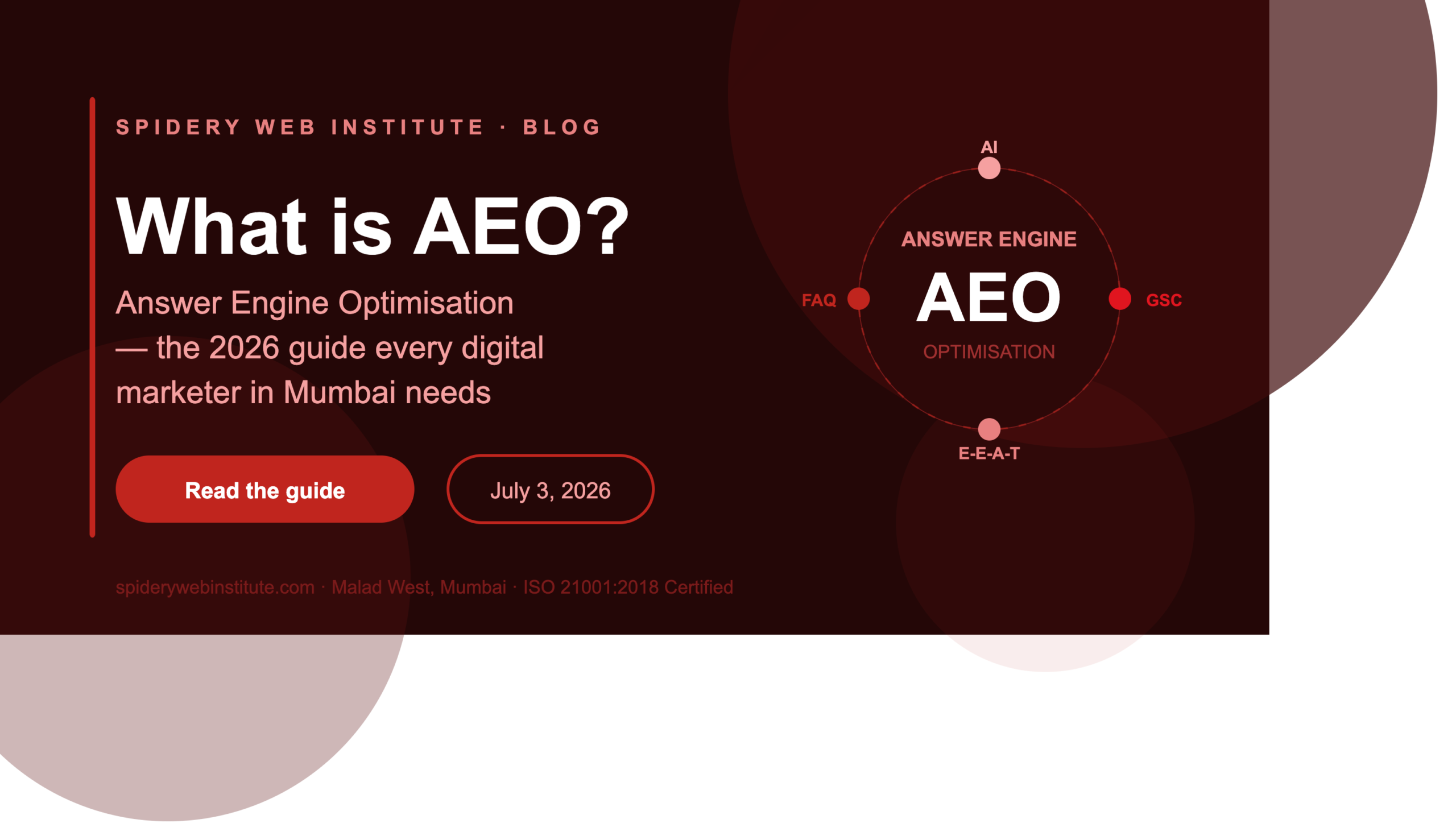
What is Answer Engine Optimisation (AEO)?
Answer Engine Optimisation (AEO) is the practice of structuring and writing your content so that AI-powered answer engines — like Google AI Overviews, ChatGPT, Perplexity, and Gemini — can extract it, understand it, and serve it directly as an answer to a user’s question.
Where traditional SEO focuses on ranking your page in a list of results, AEO focuses on making your content the answer — the snippet, the AI-generated response, the featured result that appears before anyone even sees a list.
Think of it this way:
- SEO = getting your page ranked so users can find you
- AEO = getting your content used so users do find your answer — even without visiting your page
AEO is not a replacement for SEO. It is an evolution of it. And for digital marketers in Mumbai — where competition for online attention is intensifying every quarter — understanding AEO is becoming as essential as knowing how to write a meta description.
AEO vs SEO — What’s the Actual Difference?
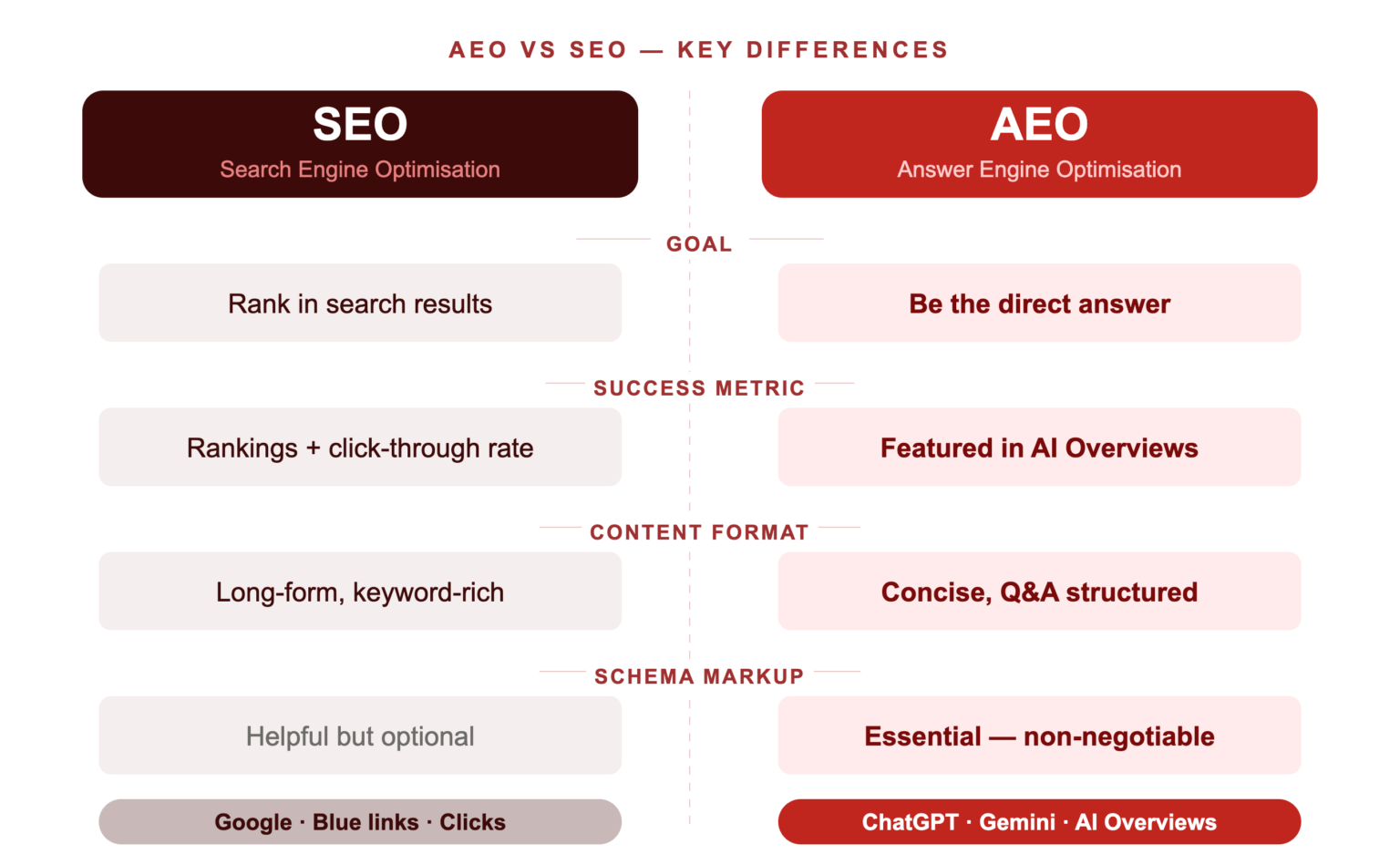
Both AEO and SEO share the same foundation: high-quality content, relevant keywords, and a technically sound website. But they diverge in what they optimise for.
| Factor | SEO | AEO |
| Primary goal | Rank in search results | Be the direct answer |
| Success metric | Click-through rate, rankings | Featured in AI Overviews, snippets |
| Content format | Long-form, keyword-rich pages | Concise, structured, question-answer format |
| Schema markup | Helpful but optional | Essential |
| Target platforms | Google Search | Google AI Overviews, ChatGPT, Perplexity, Gemini |
| User journey | User clicks → visits page | User gets answer → may or may not click |
The critical shift with AEO is that the engine itself becomes the gatekeeper. Google’s AI Overview doesn’t just list your page — it reads it, extracts the clearest answer, and presents it as its own response. If your content isn’t structured to be extractable, it won’t be used, regardless of how well it ranks.
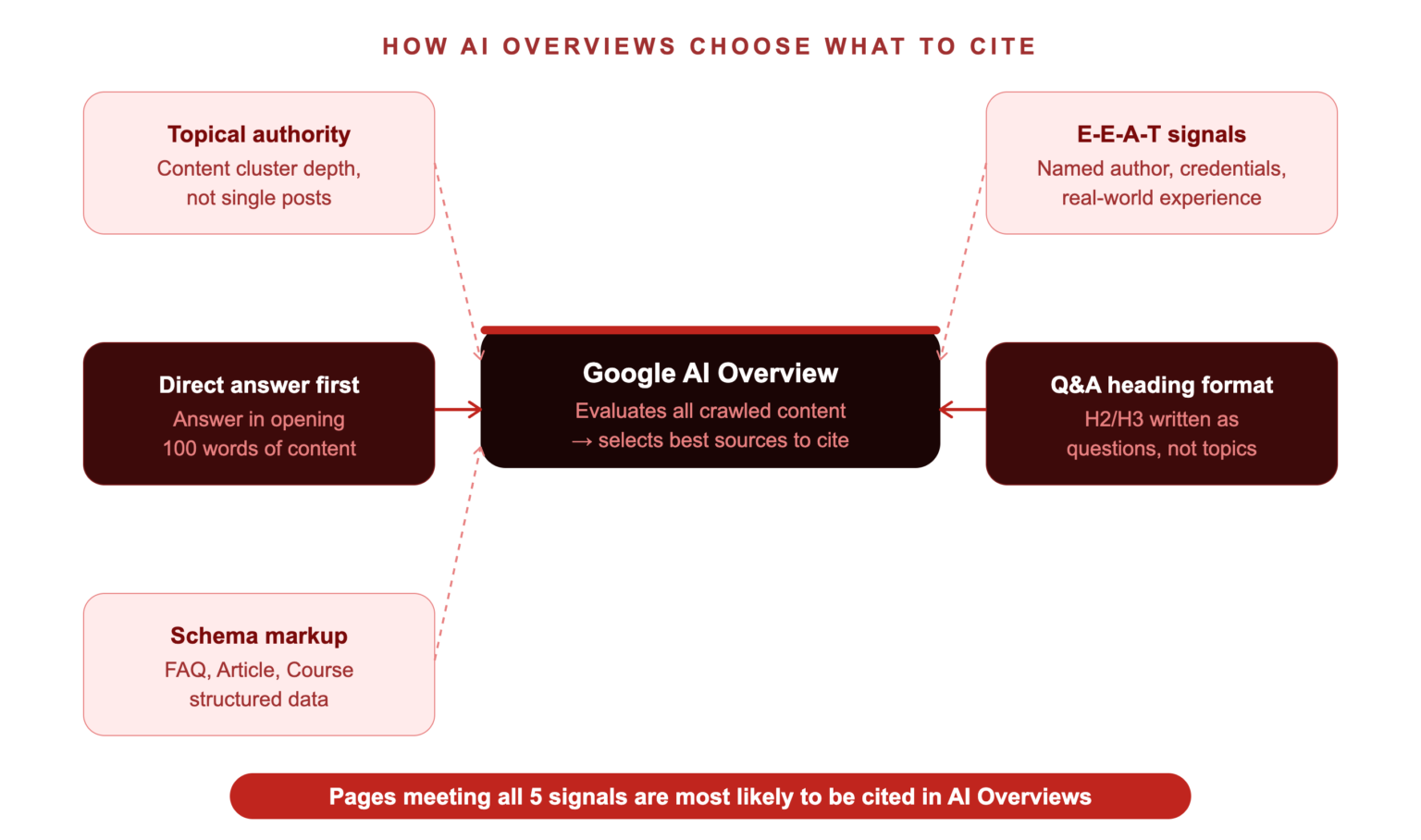
How AI Overviews Work in 2026
Google’s AI Overviews (formerly Search Generative Experience) appear at the very top of search results for informational queries. They pull content from multiple sources, synthesise it, and present a paragraph-length answer with citations shown below.
Here’s what drives which sources get cited in an AI Overview:
1. Topical authority — Google’s AI favours content from sites that have consistently written about a topic over time. One excellent blog post is not enough. A cluster of related content on the same subject builds the authority that gets you cited.
2. Clear, direct answers near the top of the page — AI models are built to extract answers efficiently. If your answer to “what is AEO” is buried in paragraph 8 after three sections of preamble, it won’t be used. Lead with the definition.
3. Structured content with proper schema — FAQ schema, How-To schema, and Article schema tell Google’s crawler exactly what type of content is on your page and how to categorise it. Pages without schema are harder for AI systems to interpret correctly.
4. E-E-A-T signals — Experience, Expertise, Authoritativeness, and Trustworthiness. AI Overviews heavily favour content from credible, named authors with demonstrable real-world expertise. Anonymous blog posts from generic websites are at a significant disadvantage.
5. Concise, well-formatted Q&A sections — Question headers (H2 or H3) followed immediately by a tight, 2–4 sentence answer are the highest-probability format for AI extraction. This is the core structure of AEO writing.
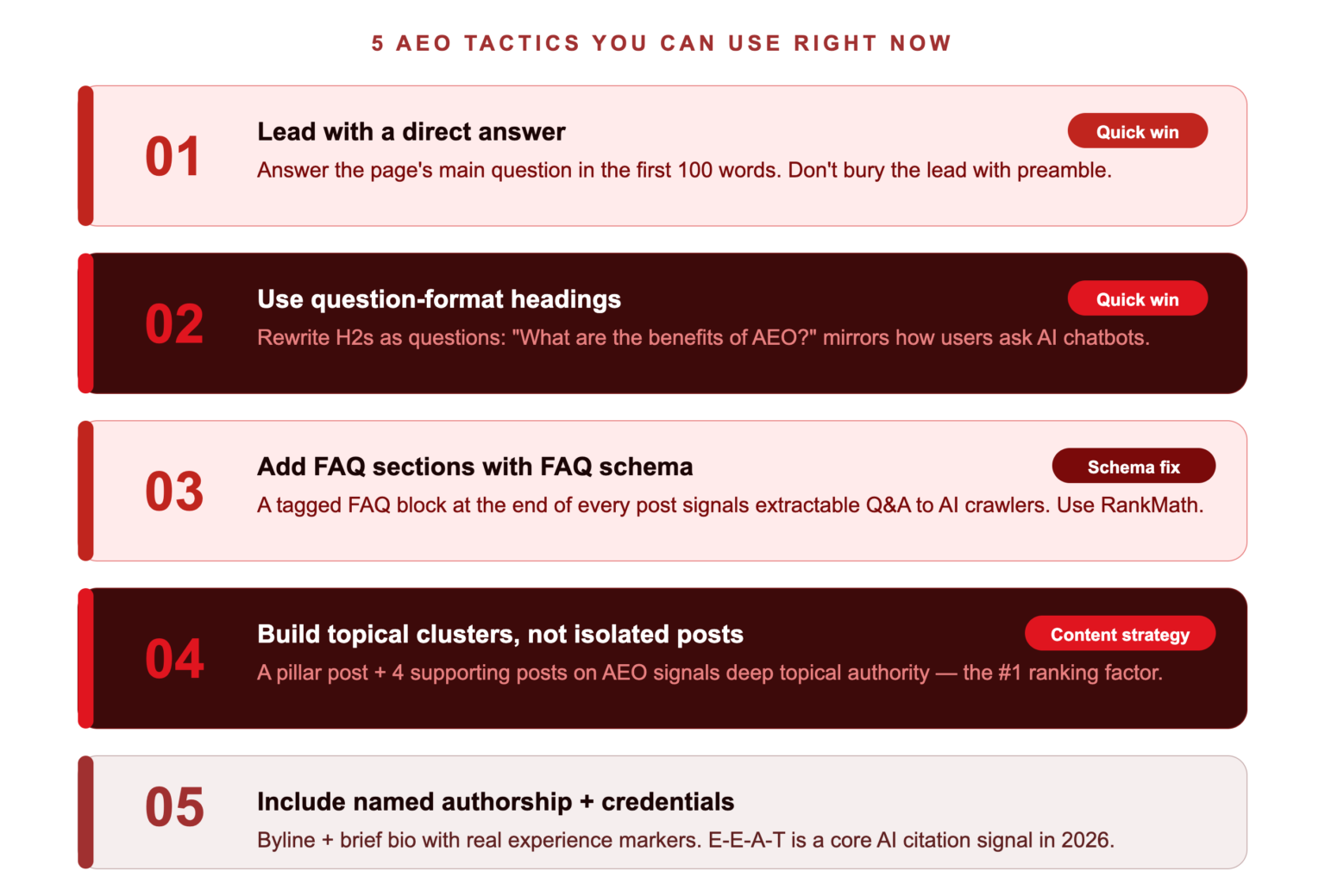
5 AEO Tactics Every Mumbai Digital Marketer Can Use Right Now
You don’t need to rebuild your website to start implementing AEO. These five tactics can be applied to any existing page or blog post.
1. Lead every page with a direct definition or answer
For any informational page, the first 100 words should contain a clear, complete answer to the page’s main question. Don’t bury the lead. If someone asks “what is AEO,” your page should answer that in the opening paragraph — not after an introduction about the history of search engines.
2. Structure your content with question-format headings
Turn your H2 and H3 subheadings into questions. Instead of “Benefits of AEO,” write “What are the benefits of AEO for digital marketers?” This mirrors how users actually phrase queries in voice search and AI chat interfaces — and it’s exactly the format AI extraction models look for.
3. Add FAQ sections with FAQ schema to every blog post
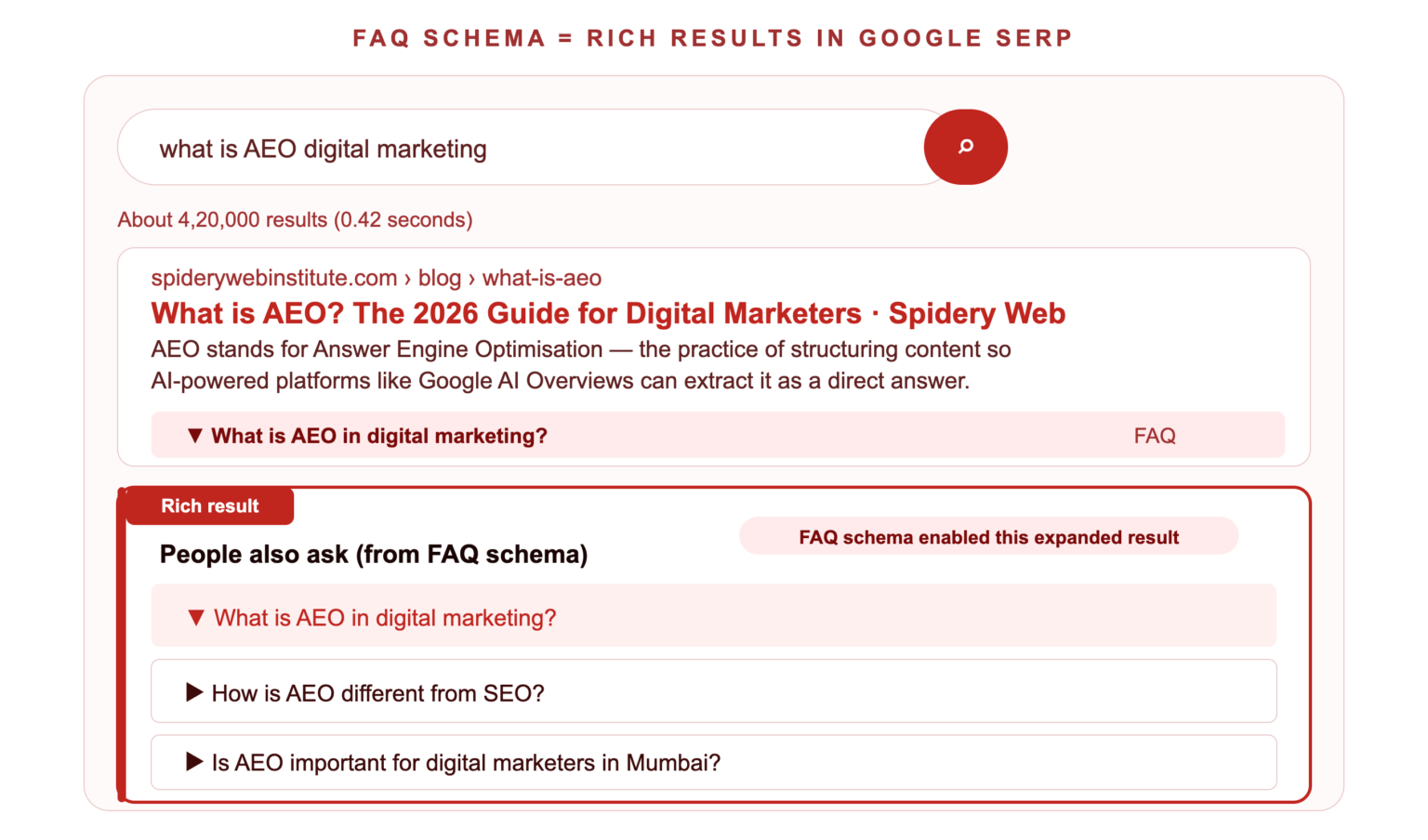
A dedicated FAQ section at the end of each blog post, marked up with FAQ schema via RankMath or Yoast, is one of the highest-impact AEO tactics available today. Each question should be answered in 2–4 sentences maximum. Concise is better than comprehensive for schema-marked answers.
4. Build topical clusters, not isolated posts
A single blog post on AEO is a starting point. What signals topical authority to AI systems is a cluster of related content: a pillar post on AEO, supporting posts on AEO for specific industries, a comparison post on AEO vs GEO, a how-to post on implementing AEO tactics. This interconnected architecture tells AI systems — and Google — that your site genuinely understands the topic.
5. Include named authorship and real credentials
AI systems weight E-E-A-T heavily. Adding a named author byline with a short bio — “Written by Faiza Khan, digital marketing practitioner with 8+ years of live campaign experience and founder of Spidery Web Institute, Malad Mumbai” — provides the credibility signal that generic content lacks. If you have case studies, certifications, or real client results, reference them.
Why Spidery Web Institute Teaches AEO as a Core Module
Most digital marketing institutes in Mumbai are still teaching SEO the way it worked in 2022. Keyword density. Backlink counts. Page rankings.
At Spidery Web Institute in Malad, we teach what actually works in 2026 — and that includes AEO as a named, dedicated module in our Advanced Digital Marketing course in Mumbai.
Our students don’t just learn AEO theory. They implement it on live campaigns for real clients managed by Spidery Web Agency. When our students graduate, they know how to write content that ranks in Google’s blue links and gets cited in AI Overviews — because they’ve already done it.
“I went from zero SEO knowledge to landing a Digital Marketing Executive role at a Mumbai agency within 60 days of completing the course.” — Sulakshana Patel, Batch 2025
That kind of result comes from practical, agency-backed training that stays current with how search actually works — not how it worked three years ago.
If you’re serious about building a digital marketing career in Mumbai in 2026, AEO isn’t a nice-to-have. It’s a baseline skill that employers are actively looking for.
→ Explore our Advanced Digital Marketing + AI + Automation Course — AEO, GEO, SEO, and 15+ AI tools, taught with live client campaigns in Malad, Mumbai.
→ Or dive deeper with our SEO + AEO + GEO Mastery Course — the only course in Mumbai dedicated to all three layers of modern search visibility.
Frequently Asked Questions About AEO
What is AEO in digital marketing? AEO stands for Answer Engine Optimisation. It is the practice of structuring website content so that AI-powered platforms like Google AI Overviews, ChatGPT, and Perplexity can extract and present it as a direct answer to a user’s question — without requiring the user to click through to the website.
How is AEO different from SEO? SEO focuses on ranking pages in traditional search result lists to earn clicks. AEO focuses on making content the featured answer that AI systems surface directly. Both are important in 2026 — AEO is not a replacement for SEO, but an additional optimisation layer on top of it.
Is AEO important for digital marketers in Mumbai? Yes. As more users in India interact with Google’s AI Overviews and AI chat tools for informational queries, digital marketers who understand AEO have a significant advantage. Brands that get cited in AI Overviews receive credibility and visibility even when users don’t click through.
How do I start with AEO if I’m a beginner? Start with three steps: (1) add a clear definition or direct answer in the first paragraph of every blog post, (2) rewrite your subheadings as questions, and (3) add a FAQ section with FAQ schema markup to each page. These three changes alone significantly improve your content’s extractability for AI systems.
Can I learn AEO at Spidery Web Institute in Malad? Yes. AEO is a dedicated module in Spidery Web Institute’s Advanced Digital Marketing + AI + Automation course, taught with live campaign application on real clients. Batch enquiries: Book a Free Demo or WhatsApp us directly.
The Bottom Line
AEO is not a trend. It is the direction search is moving — and it’s moving fast.
In 2026, ranking on page one of Google is no longer the finish line. Getting your content cited by AI Overviews, appearing in ChatGPT’s answers, and being the source Perplexity references — that is the new competitive frontier for digital marketers in Mumbai and across India.
The good news: AEO is learnable. The tactics are practical, the implementation is straightforward, and the early movers — the digital marketers and businesses that start now — will own these positions before their competitors even realise what they’ve missed.
Ready to learn AEO, GEO, and modern SEO with live campaign experience in Malad, Mumbai?
Book your free demo at Spidery Web Institute →
Written by Faiza Khan — Founder, Spidery Web Institute | Digital Marketing Practitioner, 8+ years live agency experience | Malad West, Mumbai
Spidery Web Institute is an ISO 21001:2018 and ISO 9001:2015 certified digital marketing training institute in Malad, Mumbai.