On this page
- Why practical training matters
- Step 1: A short concept, with real examples
- Step 2: Live demonstration
- Step 3: You do it yourself
- Step 4: Feedback and improvement
- Step 5: A real output every class
- Practical classroom vs theory-based learning
- How this builds confidence
- Who teaches the classes
- Is practical training right for you?
- Visit a free demo class in Malad West
- Each class follows concept, live demo, hands-on task, feedback and a real output
- You use the same tools agencies use: WordPress, Meta, Google Ads, GA4, Search Console, ManyChat and AI tools
- Small batches mean the trainer checks every student's work
- Over 5 months the outputs add up to a complete portfolio
- Practice with feedback builds the confidence employers look for
Quick answer: In a practical digital marketing class, each topic is explained briefly with real examples, then every student does the task on live tools such as WordPress, Meta Business Suite, Google Ads or Search Console, gets feedback from the trainer and improves it. Over the course, these tasks add up to a portfolio: a website, content, SEO work, ad campaigns and automations you can show employers or clients.
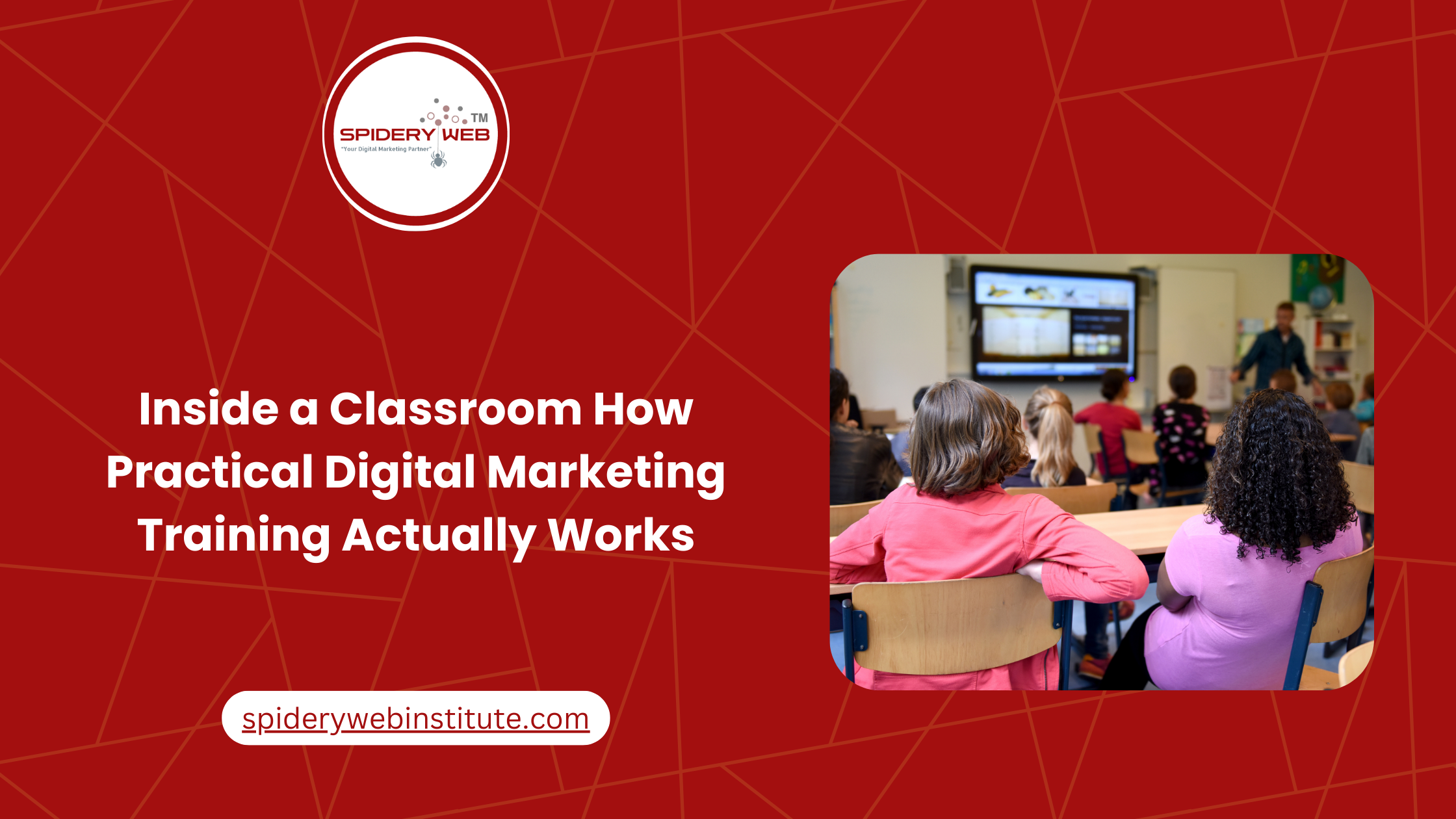
The question we hear most from students considering a digital marketing course in Malad is: "Will I actually learn to do the work, or just hear about it?" Digital marketing cannot be learned from slides. Here is what really happens inside a practical classroom at Spidery Web Institute, Malad West.
Why practical training matters
Employers and clients don't ask what you know; they ask what you have done. A practical class makes sure you have done each task at least once with guidance: set up a campaign, optimised a page, built a website, created a reel. That experience shows in interviews and client meetings.
Step 1: A short concept, with real examples
Each topic starts with a brief explanation: why it matters, where businesses use it and how results are measured. We use real search results, real brand pages and real campaign dashboards instead of long theory.
Step 2: Live demonstration
The trainer shows the task on screen, step by step, using the same tools agencies use: WordPress and Elementor, Canva, Meta Business Suite and Ads Manager, Google Ads and Keyword Planner, Google Analytics 4, Search Console, Google Business Profile, ManyChat and AI tools.
Step 3: You do it yourself
Every student then completes the task on their own laptop. The trainer moves around the room, checks work and helps when someone gets stuck. Because batches are small, nobody is left behind.
Step 4: Feedback and improvement
Your first attempt is rarely perfect, and that is the point. Captions get rewritten, page titles get improved, campaign structures get fixed. The trainer explains what professionals would change and why. This feedback loop is what recorded courses cannot give you.
Step 5: A real output every class
Every class ends with something concrete. Over 5 months these outputs build your portfolio:
| Weeks | What you produce |
|---|---|
| 1–4 | Brand kit, social posts, promotional video, talking-head reel, AI character and AI avatar reels, business social profiles |
| 5–8 | YouTube channel, Pinterest profile, LinkedIn profile and page, WordPress installation and first Elementor pages |
| 9–12 | Complete small-business website with forms and chatbot, on-page SEO scores, off-page plan |
| 13–16 | Technical SEO checklist, structured data, Google Business Profile, Meta lead campaign structure and audiences |
| 17–21 | Meta Pixel and events, Google Search campaign with conversion tracking, DM and WhatsApp automation, email marketing, final portfolio and resume |
See every class on the week-by-week syllabus.
Practical classroom vs theory-based learning
| Theory-based | Practical classroom |
|---|---|
| Definitions and slides | Doing tasks on live tools |
| Passive watching | Active work with feedback |
| Certificate at the end | Portfolio plus certificate |
| Doubts wait | Doubts solved on the spot |
How this builds confidence
By the end, students can open any ad manager, website dashboard or analytics tool without hesitation, explain what they did and why, and show proof. That confidence is what makes the difference in interviews, internships and first client meetings.
Who teaches the classes
Classes are led by Faiza Khan, founder of Spidery Web Agency, with more than 8 years of hands-on campaign experience. Because the agency runs live client work, examples in class reflect what is working right now. Meet your trainer.
Is practical training right for you?
If you want job-ready skills, learn best by doing, and want a portfolio rather than just a certificate, a practical classroom course is the right fit. The Advanced Digital Marketing + AI + Automation course is designed exactly this way.
Visit a free demo class in Malad West
Spidery Web Institute is at 302 Quantum Towers, SV Road, Malad West, Mumbai. Book a free demo class, meet the trainer and see live student work before you decide. Call or WhatsApp +91 97680 29386, or see the course fees page for current plans and instalments.
Frequently asked questions
What does a typical class look like?
Do I need my own laptop?
Will I work on real websites and accounts?
How big are the classes?
What do I have at the end of the course?
 Written by Faiza KhanPublished 9 January 2026 · Updated 11 November 2026 · ⏱ 3 min read