On this page
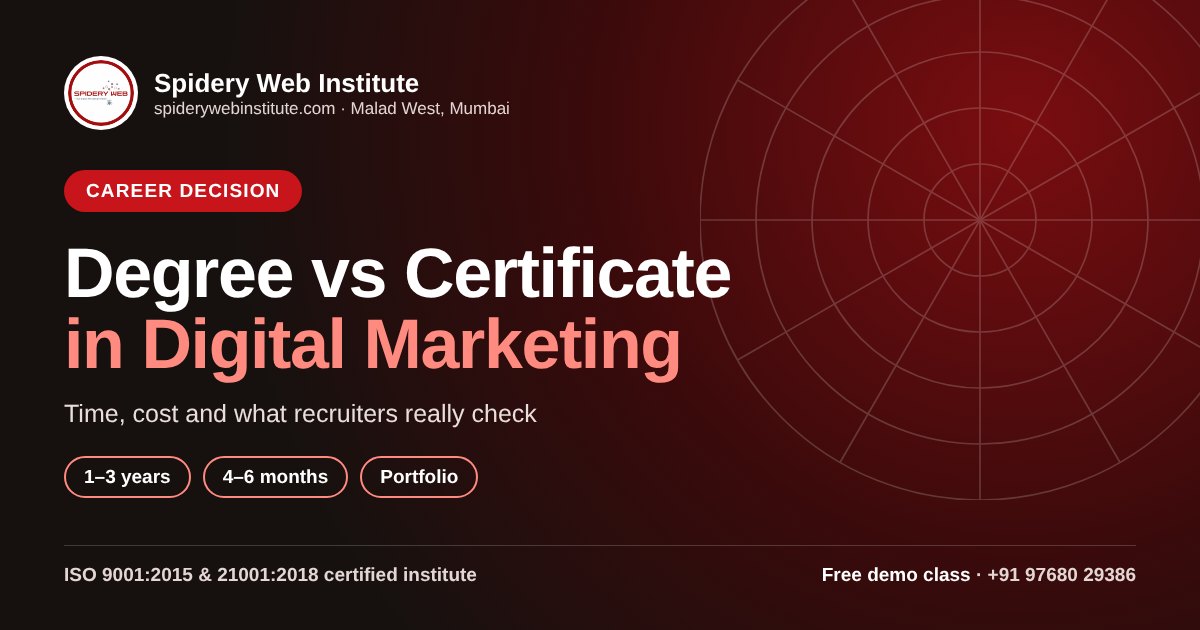
- Degrees take 1 to 3 years and cover broad business theory
- Certificate courses take 3 to 6 months and focus on job-ready tools and projects
- Most entry-level recruiters care more about your portfolio than your qualification
- Many students combine a degree with a practical weekday or weekend course
- An MBA makes most sense after a few years of experience
Quick answer: A digital marketing degree (BBA/MBA in digital marketing) takes 1–3 years and suits students who want an academic qualification; a 4–6 month certificate course is faster, cheaper and more practical for getting a job. Recruiters at agencies care more about your skills and portfolio than the degree name.
After 12th or graduation, many students face the same question: should I do a full degree in digital marketing (like a BBA or MBA with a digital marketing specialisation), or a short certificate course? The right answer depends on your goal, your time and how quickly you want to start earning. Read our complete guide to the digital marketing course after 12th — eligibility, fees, jobs and salary.
What a digital marketing degree covers
Degrees such as a BBA in Digital Marketing, BMS with a marketing specialisation or an MBA in Digital Marketing take one to three years. They cover marketing theory, consumer behaviour, business strategy, economics, communication and management — with digital marketing as one part of a broader business education.
- Pros: a recognised academic qualification, broad business knowledge, campus life and eligibility for roles that require a degree.
- Cons: long duration, higher cost, and syllabi that often lag behind how fast platforms change. Hands-on practice with live ad accounts is usually limited.
What a certificate course covers
A practical certificate course runs for three to six months and focuses on skills you use from day one at work: SEO, Google Ads, Meta Ads, social media, content, WordPress, analytics, AI tools and automation.
- Pros: fast, affordable, job-focused and updated frequently. Good courses include live projects and a portfolio.
- Cons: not an academic degree, and quality varies a lot between institutes — so choose carefully.
Cost, time and job outcomes compared
| Degree | Certificate course | |
|---|---|---|
| Duration | 1–3 years | 3–6 months |
| Typical cost | ₹1.5 lakh – ₹10 lakh+ | ₹20,000 – ₹60,000 |
| Focus | Theory + broad business | Hands-on tools and campaigns |
| Portfolio at the end | Sometimes | Yes, in good courses |
| Time to first job | After graduation | Often during or right after the course |
| Best for | Students wanting a formal qualification | Students and professionals wanting job-ready skills fast |
Which one recruiters prefer
For entry-level roles at agencies, startups and most brands, recruiters care far more about what you can do than the name of your qualification. In interviews they ask you to explain a campaign, show a website you built or audit their page on the spot. A degree helps with some large companies and for management roles later, but a strong portfolio is what gets most freshers hired.
Read our guide to the digital marketing salary in India to see how skills — not degrees — drive pay growth.
How to decide in 3 questions
- Do you already have (or are you doing) a degree? If yes, add a certificate course; a second degree is rarely necessary.
- Do you need to earn soon? If yes, choose a certificate course with placement support.
- Do you want senior management roles in large corporates long-term? A degree or MBA can help later — after you have practical experience.
What employers in Mumbai actually check
We regularly speak with agencies and brands hiring our students. When they shortlist a fresher for a digital marketing role, they usually look at four things, in this order:
- A portfolio: a website you built, ad campaigns you ran, social media pages you grew, or blog posts that rank.
- Tool skills: Google Ads, Meta Ads Manager, Google Analytics, Search Console, Canva and AI tools.
- Communication: can you explain your results clearly in an interview?
- Qualification: a degree in any stream plus a recognised certificate.
Notice that the qualification matters, but it rarely decides the job on its own. A degree gets you through the HR filter; practical proof gets you the offer.
Can you combine both?
Yes — and for most students this is the smartest option. You can study a B.Com, BMS, BMM or any other degree and attend a classroom certificate course in the afternoon or on weekends. By the time you graduate you have:
- a degree for eligibility,
- an ISO-certified certificate for skills,
- and a portfolio of live work to show in interviews.
Working professionals can do the same in reverse: keep your job, take a weekend batch, and switch roles once your portfolio is ready. A certificate course costing ₹30,000–₹40,000 is a fraction of a full degree fee and can pay for itself within your first few months of work.
Frequently asked questions
Is a degree required for digital marketing jobs? No. Most agencies and startups hire on skills and portfolio; a certificate course plus projects is enough to start.
Which is better: an MBA in digital marketing or a certificate course? If you already have a degree and want a job quickly, a practical certificate course is usually the better return. An MBA makes more sense after two or three years of experience.
Learn this hands-on
Spidery Web Institute’s 5-month Advanced Digital Marketing + AI + Automation course is designed to sit alongside college or work, with weekday afternoon and weekend batches in Malad West. Read what a digital marketing course includes or book a free demo class.
Frequently asked questions
Is a degree required for digital marketing jobs?
Which is better: MBA in digital marketing or a certificate course?
Can I do a certificate course while studying for a degree?
Is a certificate course enough to get a job?
How much does a certificate course cost?
 Written by Faiza KhanPublished 10 November 2026 · Updated 16 November 2026 · ⏱ 4 min read