
Digital marketing has changed dramatically over the last few years. Businesses are no longer competing only for attention on social media or through paid advertisements. They are also competing for visibility whenever customers search on Google, Maps, AI-powered search platforms, and other discovery channels.
This is where Search Engine Optimization, or SEO, becomes important.
SEO helps a website appear in front of people who are already searching for information, products, services, courses, or solutions. Instead of interrupting users with advertising, SEO allows businesses to meet potential customers at the moment they are actively looking for something.
For example, someone searching for a digital marketing course in Mumbai is already showing a strong interest in learning digital marketing. Similarly, a search for an SEO course in Malad Mumbai indicates that the person is looking for specialized training in a particular location.
For students, professionals, entrepreneurs, and business owners, understanding SEO has therefore become an important part of understanding digital marketing itself.
At Spidery Web Institute, SEO is taught as part of the larger digital marketing ecosystem so learners understand not only how rankings work, but how search visibility can contribute to traffic, enquiries, leads, and business growth.
What Is SEO?
SEO stands for Search Engine Optimization.
It is the process of improving a website and its content so that search engines can better understand it and users can find it for relevant searches.
SEO can involve several areas, including:
- Keyword research
- On-page SEO
- Technical SEO
- Content optimization
- Internal linking
- Link building
- Local SEO
- Website speed optimization
- Mobile usability
- User experience
- Google Search Console
- SEO analytics
- Search intent optimization
Modern SEO is no longer about repeatedly placing keywords on a page. Search engines increasingly focus on whether content genuinely answers what a user is searching for.
Why Is SEO Important in a Digital Marketing Strategy?
SEO is important because search continues to be one of the main ways people discover businesses, services, information, and brands online.
Consider a simple example.
A student wants to build a career in digital marketing and searches:
“digital marketing institute in Mumbai”
The institutes appearing prominently in the search results have a much better opportunity to attract that student than institutes that cannot easily be found online.
The same principle applies to almost every industry.
People search before choosing restaurants, doctors, agencies, educational institutes, products, software, travel services, real estate projects, and professional services.
SEO helps businesses become visible during these decision-making moments.
1. SEO Helps Generate Organic Website Traffic
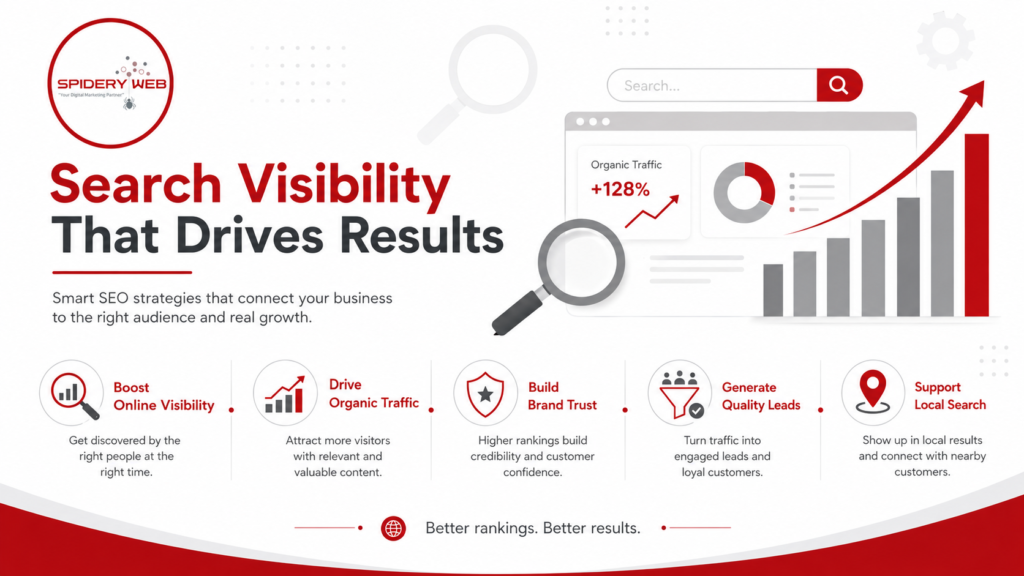
One of the biggest benefits of SEO is organic traffic.
Organic traffic refers to visitors who reach your website through unpaid search results.
If a business ranks for relevant search queries, it can continuously receive visitors without paying for every click.
For example, ranking for terms related to:
- digital marketing training
- SEO training
- digital marketing classes
- performance marketing course
- social media marketing course
- Google Ads training
can help an educational website attract people genuinely interested in those subjects.
This is one reason students choosing a Best digital marketing course in Mumbai should understand how organic search works rather than focusing only on paid advertising.
2. SEO Targets People With Search Intent
SEO is powerful because users usually initiate the search themselves.
Someone searching for:
has a different level of intent compared with someone casually scrolling through Instagram.
Search queries provide clues about what users actually want.
Understanding this is known as search intent optimization.
Search intent can generally be divided into:
Informational intent:
The user wants to learn something.
Example: “What is technical SEO?”
Commercial intent:
The user is researching options.
Example: “Best digital marketing institute in Mumbai”
Transactional intent:
The user may be ready to take action.
Example: “Join digital marketing course in Malad”
Understanding these differences allows marketers to create content for different stages of the customer journey.
3. SEO Can Deliver Long-Term Marketing Value
Paid advertising can produce faster visibility, but the visibility generally depends on continuing ad spend.
SEO works differently.
A well-optimized article or service page can continue generating impressions and visitors long after it has been published.
That does not mean SEO is free or requires no maintenance. Rankings can change, competitors can improve their websites, search algorithms evolve, and content may require updates.
However, strong SEO assets can create lasting marketing value.
This is why many successful digital marketing strategies combine SEO and paid advertising rather than choosing only one.
4. SEO Builds Brand Visibility and Credibility
Users frequently encounter the same brands while researching a topic.
Imagine someone searching multiple questions such as:
- What is SEO?
- How long does SEO take?
- What is local SEO?
- SEO vs Google Ads
- How to learn SEO?
- Best SEO course in Malad
If the same brand repeatedly provides useful answers, people gradually become familiar with it.
SEO therefore contributes not only to clicks but also to brand awareness and topical authority.
Appearing consistently for relevant searches can help position a business as a useful resource within its industry.
5. SEO Supports Content Marketing
SEO and content marketing work closely together.
SEO helps identify what people are searching for, while content marketing creates information that answers those searches.
Keyword research can reveal topics, questions, problems, and interests within a target audience.
For example, a digital marketing course in Mumbai could create educational content around:
- SEO career opportunities
- Google Ads strategies
- Social media marketing
- AI tools for marketers
- AEO
- GEO
- Content marketing
- Performance marketing
- WordPress
- Marketing automation
Instead of publishing random content, SEO helps brands build a content strategy around actual user demand.
6. Local SEO Helps Businesses Reach Nearby Customers
For businesses that serve a particular location, local SEO is especially important.
Local optimization helps businesses become more visible for searches that include geographic intent.
For example:
digital marketing course Malad Mumbai
or
SEO course in Malad Mumbai
These searches are highly location-specific.
Local SEO strategies may include:
- Google Business Profile optimization
- Local keyword targeting
- Consistent business information
- Customer reviews
- Local landing pages
- Relevant local content
- Maps visibility
For educational institutes, clinics, restaurants, agencies, gyms, salons, and other location-based businesses, local SEO can play a major role in lead generation.
7. SEO Improves Overall Website Quality
Good SEO often requires improving the website itself.
Technical factors such as slow loading speeds, confusing navigation, broken links, poor mobile usability, or badly structured pages can affect both search performance and user experience.
SEO therefore encourages businesses to improve areas such as:
- Page speed
- Mobile responsiveness
- Website architecture
- Internal linking
- Navigation
- Content structure
- HTTPS security
- Image optimization
- Core Web Vitals
These improvements can benefit visitors even when they arrive from channels other than Google.
8. SEO Provides Valuable Marketing Data
SEO platforms provide useful information about customer behaviour.
Tools such as Google Search Console and Google Analytics can help marketers understand:
- What people search before visiting a website
- Which pages receive the most traffic
- Which keywords generate impressions
- Which pages are gaining or losing visibility
- Where visitors come from
- Which content performs well
- How users interact with a website
This data can influence SEO, advertising, content marketing, and broader business decisions.
Students enrolling in a digital marketing course in Mumbai should therefore learn how to interpret marketing data rather than simply memorizing SEO terminology.
SEO in 2026: It Is No Longer Only About Google Rankings
Search behaviour continues to evolve.
People now receive information through traditional search results, featured snippets, voice assistants, AI-generated answers, Maps, videos, social platforms, and generative search experiences.
Because of this, modern marketers are increasingly learning SEO alongside:
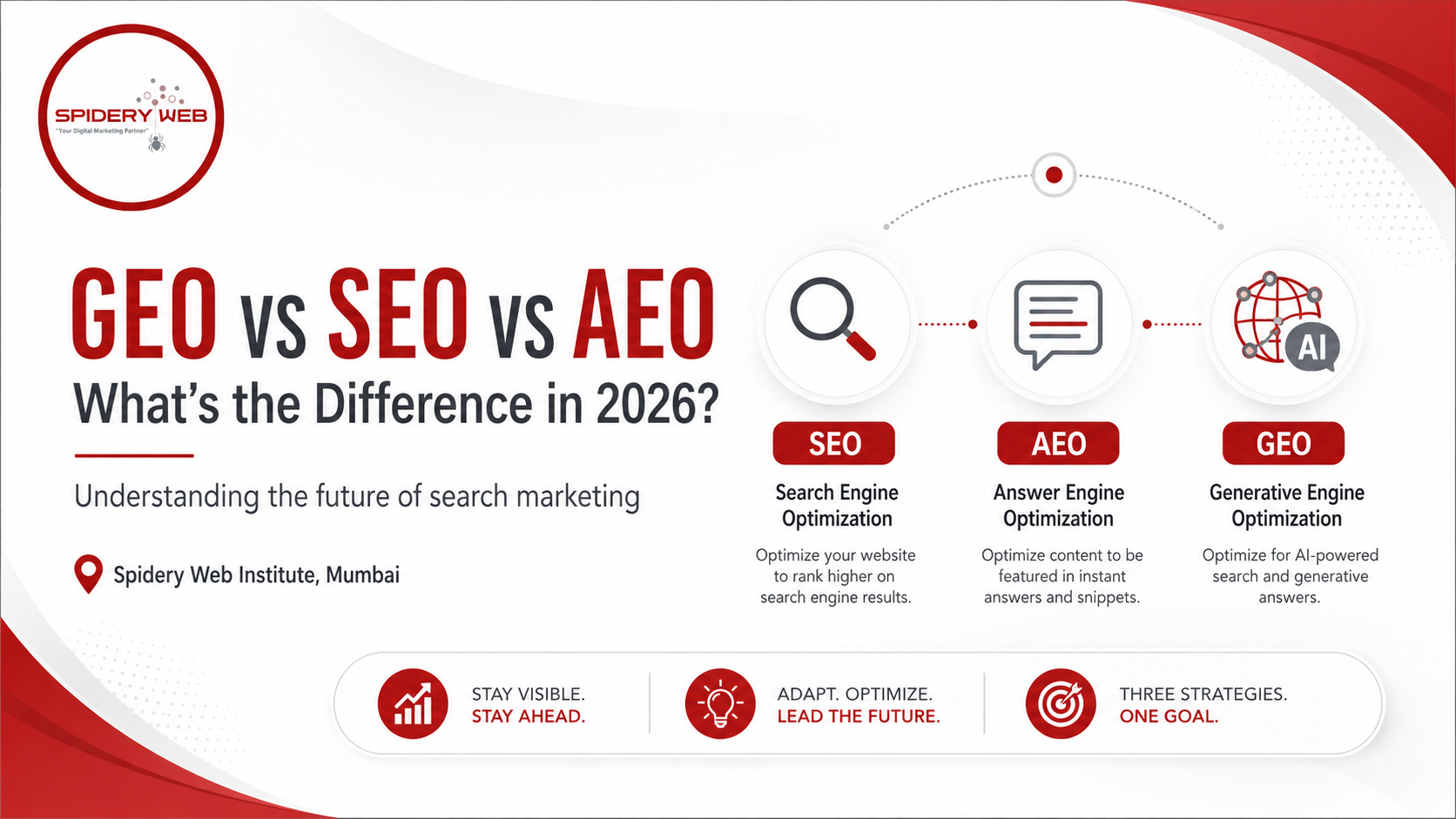
AEO – Answer Engine Optimization
AEO focuses on structuring content so that search engines and answer platforms can easily identify direct, useful responses to questions.
GEO – Generative Engine Optimization
GEO focuses on making content understandable, credible, and useful for AI-powered and generative search environments.
SEO, AEO, and GEO should not necessarily be viewed as competitors.
They are increasingly becoming connected parts of a broader search visibility strategy.
What Should Students Learn in an SEO Course?
SEO is best learned practically.
A good SEO course in Malad Mumbai should ideally teach learners how to work on real websites rather than only explaining definitions.
Important areas include keyword research, competitor analysis, on-page SEO, technical SEO, local SEO, content optimization, link building, Google Search Console, Google Analytics, website audits, SEO reporting, AEO and GEO.
At Spidery Web Institute, these concepts are included within practical digital marketing training so students can understand how SEO connects with Google Ads, social media marketing, WordPress, AI tools, content marketing and marketing automation.
For someone comparing a digital marketing institute in Mumbai, practical implementation should be an important factor when evaluating a course.
SEO Works Best as Part of a Complete Digital Marketing Strategy
SEO alone cannot solve every marketing challenge.
The strongest strategies usually combine multiple channels.
SEO can help attract organic visitors. Google Ads can provide immediate paid visibility. Social media can build awareness and engagement. Content marketing can educate prospects. Email and automation can nurture leads.
Together, these channels support different stages of the customer journey.
This is why SEO should not be treated as an isolated activity. It should work alongside the wider digital marketing strategy.
SEO remains important because people continue to search before making decisions.
Whether someone is looking for a service, researching a product, comparing businesses, or searching for a digital marketing course in Mumbai, appearing at the right moment can create valuable opportunities.
SEO helps businesses increase organic visibility, attract relevant traffic, strengthen credibility, improve website experience and create long-term digital assets.
At the same time, search marketing is evolving. Professionals entering the industry now need to understand traditional SEO along with local SEO, content strategy, AEO, GEO, analytics and AI-driven search.
For learners looking for a digital marketing institute in Mumbai, digital marketing course Malad Mumbai, or SEO course in Malad Mumbai, developing practical SEO skills can provide a strong foundation for careers in digital marketing, content, performance marketing and search strategy.
Spidery Web Institute – Malad West, Mumbai
Practical Digital Marketing Training with SEO, Google Ads, Meta Ads, WordPress, AI Tools, AEO, GEO, Content Marketing and Automation.
FAQs
Is SEO still important in 2026?
Yes. SEO remains important, although search is expanding beyond traditional Google results. Modern strategies increasingly include local SEO, AEO, GEO and optimization for AI-powered search experiences.
How does SEO support digital marketing?
SEO helps bring relevant organic traffic to a website and supports content marketing, lead generation, brand visibility, local search and customer acquisition.
Is SEO better than Google Ads?
They serve different purposes. Google Ads can provide immediate paid visibility, while SEO focuses on building organic visibility over time. Many businesses use both.
Can beginners learn SEO?
Yes. Beginners can learn SEO by understanding search intent, keyword research, content optimization, technical basics and analytics, followed by practical website implementation.
What should I look for in an SEO course in Malad Mumbai?
Look for practical training covering keyword research, on-page SEO, technical SEO, local SEO, Google Search Console, analytics, content strategy, AEO and GEO rather than a course focused only on theory.